
North America and Asia: might collide to form next supercontinent on Earth, predicts scientist :Is Amasia: The next supercontinent?
Today, As we all know that we have seven continents, but an intriguing future awaits us.
North America and Asia might collide to form next supercontinent on Earth, predicts scientist
)
A geophysicist explores the distant future about what Earth might look like when all its continents merge into a single vast landmass.
Today, As we all know that we have seven continents, but an intriguing future awaits us.
Geophysicist Ross Mitchell has recently unveiled his new book: "The Next Supercontinent" in which he talks about not only the past but also the distant future regarding what Earth might look like when all its continents merge into a single vast landmass.
Brief history
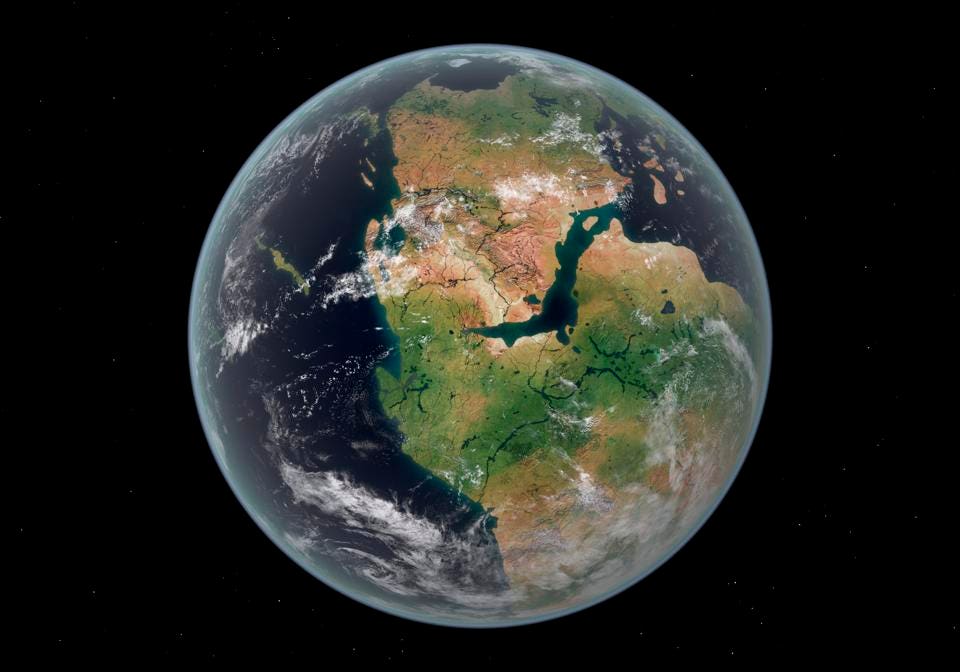
Mitchell takes us on a journey through time, exploring how the continents joined forces in the past to form supercontinents. We begin around 300 to 200 million years ago with Pangaea, a lush world filled with dinosaurs, centered on present-day Africa.
Travelling further back, we encounter Rodinia, a billion years ago, a barren landmass that included much of today's North America and Greenland. Then, two billion years ago, there was Columbia, the Siberia-centric first supercontinent, as some scientists believe.
Understanding how continents move
Understanding the movements of continents requires meticulous investigation. Scientists gather samples through fieldwork, determining the rock's age and latitude when it formed.
The formation and breakup of supercontinents are linked to the behaviour of the "solid but pliable" mantle. Mantle is the layer between the Earth's crust and core that stores ever-existing heat.
As per the book, the movement of continents occurs as heat rises in the mantle. The continents move towards that spot in the mantle which is comparatively cooler than other parts. That's how continents collide with each other, heralding the birth of a new supercontinent.
Eventually, when heat starts building up in the mantle below that giant continent, it starts to tear apart again, leading to the creation of new oceans and initiating another cycle.
Is Amasia: The next supercontinent?
Drawing from this knowledge of the past and understanding mantle mechanics, Mitchell predicts "Amasia" as the next supercontinent.
Contrary to some theories suggesting it could form from the closing of the Pacific or Atlantic oceans, Mitchell argues that Amasia will emerge through the disappearance of the Arctic Ocean.
As per his prediction, Amasia will form out of the merger of North America and Asia.
However, whether Mitchell's predictions about Amasia are accurate remains a question that none of us will live long enough to answer. It will be a matter for our coming generations to discover.

Post a Comment